
AI usage in the classroom, it has its place but children should still think for themselves
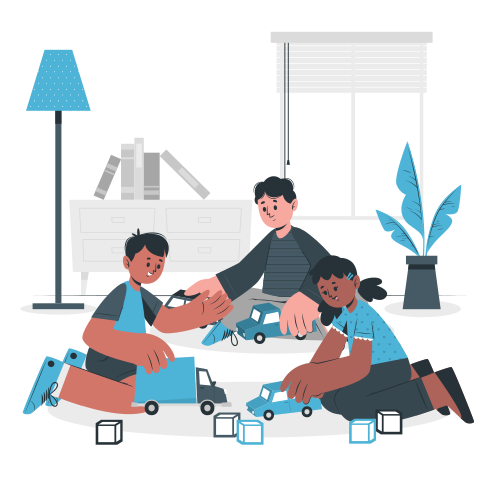
Play is often regarded as something children do after their schoolwork and chores are finished. As children grow older, their free time is gradually replaced by homework, sport, lessons and other responsibilities. Adults become even busier, and playing may begin to feel unproductive or childish. However, play is not simply a break from learning or work. It can support creativity, emotional wellbeing, problem solving and relationships throughout our lives. In her talk, Why Everyone Needs to Play!, Mila Rojas challenges the idea that play belongs only to childhood. She encourages adults to think back to the activities they loved when they were 11 years old. Did they enjoy building, drawing, dancing, playing games, riding bicycles or making up stories? Her message is simple: growing older does not mean that we should stop playing. However, play is not simply a break from learning or work. It can support creativity, emotional wellbeing, problem solving and relationships throughout our lives. In her talk, "Why Everyone Needs to Play!", Mila Rojas challenges the idea that play belongs only to childhood. She encourages adults to think back to the activities they loved when they were 11 years old. Did they enjoy building, drawing, dancing, playing games, riding bicycles or making up stories? Her message is simple: growing older does not mean that we should stop playing. Play is an important part of learning For children, play is one of the most natural ways to learn. When children build a tower, create an imaginary shop or invent the rules of a game, they are doing much more than entertaining themselves. They are learning how to: solve problems; communicate their ideas; cooperate with others; manage disappointment; negotiate rules; use their imagination; make decisions; and try again when something does not work. The American Academy of Pediatrics explains that appropriate play with parents and other children helps to develop language, emotional regulation, social skills and important thinking abilities. Play also gives children a safe space in which to explore their world and practise new skills. A child building a bridge with blocks is experimenting with balance and structure. Children playing a card game are using numbers, memory and strategy. A group creating an imaginary restaurant is practising language, cooperation and problem solving.Learning does not always need to look like formal schoolwork. Adults also need opportunities to play Adults may not play in exactly the same way as children, but play remains valuable. It may involve gardening, painting, dancing, solving a puzzle, playing a social sport, creating music, baking for enjoyment or playing a board game with friends. Research into adult playfulness has found positive relationships between playfulness and aspects of wellbeing, including positive emotions, engagement, relationships and life satisfaction. This does not mean that play removes the challenges and responsibilities of adult life. It means that enjoyable, voluntary activities may help adults reconnect with curiosity and creativity. Play can give adults permission to: take a break from constant productivity; experiment without fearing mistakes; enjoy the present moment; connect socially with others; and rediscover interests that have been neglected. An adult who plays is not being irresponsible. A healthy life needs room for responsibility, rest, connection and enjoyment. Playing together benefits children and adults Playing with children is not only beneficial for the child. Shared play can also help parents and caregivers become more present and attentive. The American Academy of Pediatrics reports that positive parenting activities, including playing and reading together, can reduce parental stress and strengthen the relationship between parent and child. When adults join children in play, they enter the child’s world. This creates opportunities for conversation, laughter and connection that may not occur during rushed daily routines. Responsive interaction is especially valuable for young children. Harvard University’s Center on the Developing Child describes the importance of “serve and return” interaction. A child makes a sound, gesture or comment, and a caring adult responds. These repeated interactions help to build healthy brain development and secure relationships. Shared play naturally creates many of these moments. A parent rolls a ball and the child rolls it back. A child invents a character and the adult responds as another character. A child adds a block to a tower and the adult follows their idea. The toy or activity is less important than the interaction. Adults should participate without taking over There is a difference between playing with a child and controlling the child’s play. Adults often want to explain the correct way to build something, organise the activity or prevent every mistake. However, child directed play gives children opportunities to make choices, test their ideas and solve problems independently. Parents and caregivers can participate by: following the child’s lead; showing interest in the child’s ideas; asking open questions; allowing harmless mistakes; avoiding unnecessary correction; and giving the child time to find a solution. Instead of saying, “That is not how you build a house,” an adult could ask, “Tell me about what you are building.” Instead of immediately correcting the rules of an invented game, the adult could ask the child to explain how the game works. The aim is not to produce a perfect result. The value lies in imagining, experimenting and connecting. Simple ways to introduce more play Play does not require expensive toys, special equipment or a carefully planned programme. Families can begin with ordinary objects and activities. Have a family game evening Play cards, complete a puzzle or choose a board game. Allow different family members to choose the game each week. Go outside Kick a ball, take a walk, play with pets, explore the garden or invent a simple obstacle course. Create something together Draw, paint, bake, build with recycled boxes or make up a story. The activity does not need to produce something perfect. Let children teach the adults Ask your child to teach you a game or activity they enjoy. This gives the child confidence and allows the adult to enter the child’s world. Rediscover an old interest Think back to what you loved doing when you were younger. Try it again, even if you feel a little self-conscious at first. Protect time for unstructured play Children also need time in which every minute is not organised by an adult. Boredom can become the starting point for imagination, experimentation and independent play. Conclusion Mila Rojas reminds us that play should not have an age limit. Children need play to explore, learn and develop, while adults can benefit from the enjoyment, connection and creativity it brings. When adults play with children, both have an opportunity to slow down and enjoy one another’s company. The child receives attention, encouragement and a safe place to explore. The adult is reminded that not every valuable activity needs to have a measurable outcome. Play does not need to be earned after everything else has been completed. It is a valuable part of a balanced and connected life. With many IEB schools currently on holiday, this is the perfect opportunity for families to rekindle the habit of playing together. It does not have to involve expensive outings or carefully planned activities. A board game, a ball in the garden, baking, drawing or simply laughing over an invented game can create lasting memories. Put some of the usual routines aside, follow your child’s lead and enjoy quality time together. The holiday will pass quickly, but the connection created through play may remain long afterwards. Bibliography: American Academy of Pediatrics. (2018). The Power of Play: A Pediatric Role in Enhancing Development in Young Children. American Psychological Association. (2020). The Many Wondrous Benefits of Unstructured Play. Farley, A., Kennedy-Behr, A. and Brown, T. (2021). An Investigation Into the Relationship Between Playfulness and Well-being in Australian Adults. Harvard University Center on the Developing Child. Serve and Return: Back-and-Forth Exchanges. Rojas, M. (2026). Why Everyone Needs to Play! TEDxSaintAndrewsSchool and Play@TED. Referenced in Saint Andrew’s School: Student Milestones Highlight a Standout Season for Saint Andrew’s TED Program.

Somewhere between five and fifteen, something changes. It is not that children lose their imagination. It is that, without quite meaning to, we often teach them to put it away.

The Real Value of Extra Curricular Activities
Study Strategies That Actually Work for High School Learners

In South Africa, where schools differ widely in approach, culture and academic focus, finding the right fit requires more than comparing results and facilities. The goal is to choose a school that supports your child’s academic progress, emotional wellbeing and long-term development.